
How to stop key knowledge from living in one person's head
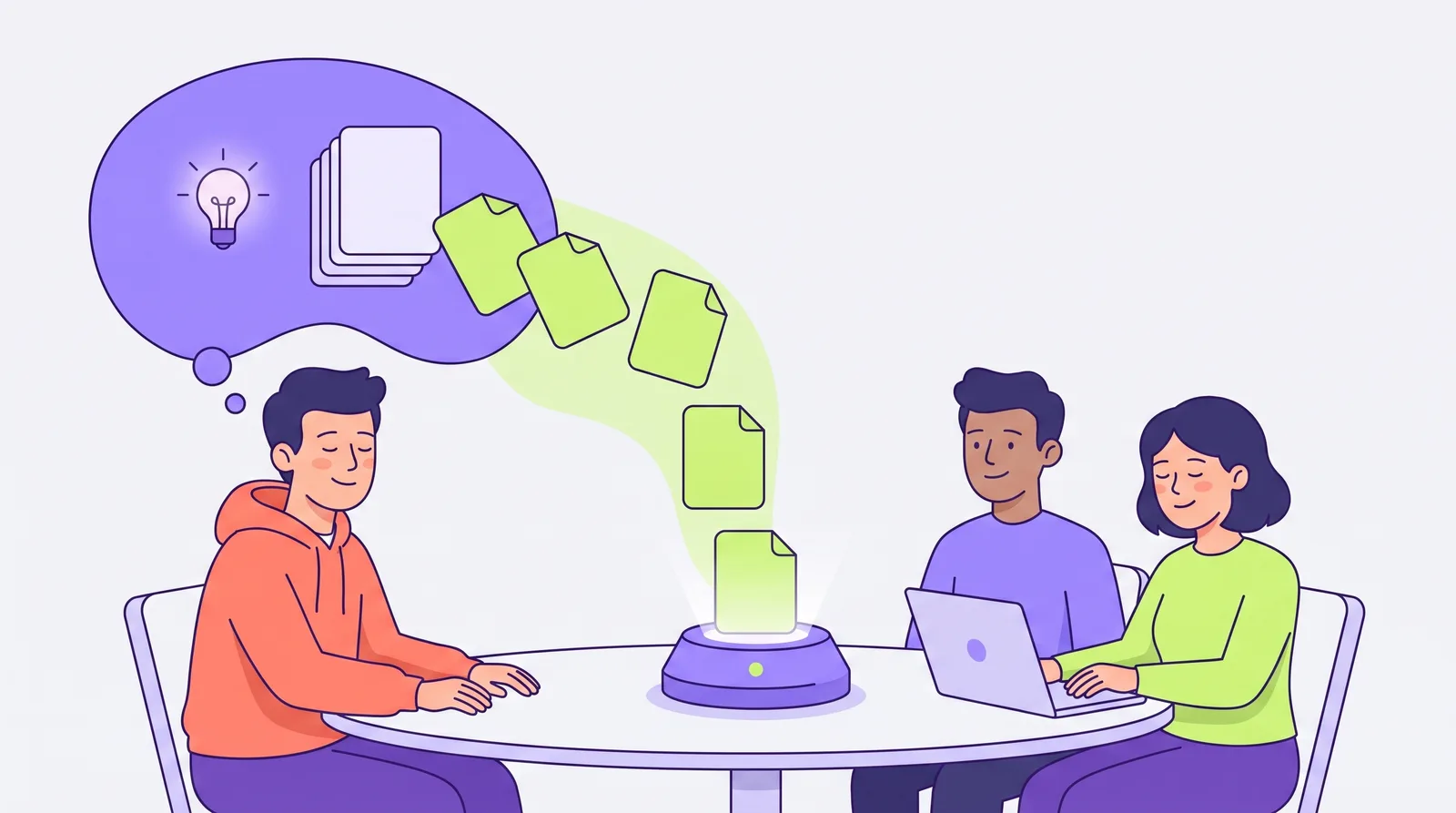
There is probably someone on your team who knows how something really works, perhaps a veteran employee who’s been there before anyone else joined. Maybe it’s the person who manages your biggest client, or the marketing guy. Maybe it’s you.
For a small team, that can feel normal and even efficient. But that unshared knowledge can cost the team valuable time. And what if that person becomes unavailable for a day? The task can be handed off, but if the context stays with just one person, how can you keep things moving?
The task gets handed off. The context doesn’t.
The truth is teams hand off work constantly: from a designer to a contractor to a client. Usually, the task itself is easy enough to explain. But the real challenge is transferring everything the original owner has learned along the way.
Sure, the new person might get the brief, the deadline, and the required deliverables. But what about the actual conversations that shaped them? They may know what the client asked for without knowing why the team agreed to it. They may see the final process without knowing which alternatives were already tried or which mistakes to avoid.
This is why a team can have capable people and still feel like certain work can only be done by one person. The problem is not a lack of skill. It’s because knowledge was never fully transferred.
The “what” is not enough
Most documentation sounds like this: “follow this process”, “use this template”, “send this report on Friday”. That information is useful when everything goes according to plan, but it becomes much less useful sooner or later.
The missing piece is the reasoning, the “why” behind the “what”. If someone knows that a client prefers short copy, they can follow the instructions. If they know that longer copy previously attracted the wrong audience, they also have a reason they can use when the client asks for something different.
The difference can be simple. Instead of writing, “Send the draft on Thursday,” write, “Send the draft on Thursday because the client reviews it on Friday morning, and sending it later usually pushes feedback into the following week.” The first tells someone what to do. The second gives them enough context to make a good decision when the usual process no longer applies.
The same principle applies to larger decisions. It’s not enough for a team to simply understand the campaign structure, but also the useful knowledge: which audience was tested? Which ones produced cheaper leads? Which ones generated qualified calls? That reasoning helps the next person understand what the team is optimizing for instead of simply copying an old decision.
The question now is: how do we transfer this nuanced knowledge?
Why documentation keeps failing
Most teams already know they should document important knowledge. The problem is that traditional documentation often makes knowledge capture feel like another job.
A team might create a wiki. But hours documenting can feel less important and boring than finishing the work already on your plate. Updating wikis becomes another tedious task that your team would rather skip. Not because they’re lazy, but because they don’t see the immediate benefits.
What you need is to capture knowledge where it is already being created. There needs to be a concrete change in your process that allows you to record the decision and the reason.
AI makes captured knowledge more useful
AI changes the game. It can help a teammate understand a project without the original expert having to explain everything again. You may think that it’s just as tedious as writing a wiki but that’s because you haven’t explored what it can actually do for you.
Why tools like ChatGPT forget your company is often the reason a new teammate struggles to pick up where someone else left off: if the important details are trapped in someone’s memory, they have to start from scratch.
A shared record gives both people and AI something to work from. Instead of rebuilding the brief every time, a teammate can look at the decisions, client history and reasoning that already exist. They can then direct AI to use that context when planning the work. This also means you can stop re-explaining context to AI every time you need help with a recurring project.
You do not need to build a knowledge base before this becomes useful. If you are unsure where to begin, look at what to delegate to AI and start with work that is repetitive or unnecessarily dependent on one person.
When that happens, capture three things:
- what was decided
- why it was decided
- what to do if the situation changes
You can even turn a brain dump into tasks with AI instead of waiting until you have time to organize everything into perfect documentation. That small habit turns knowledge into something the whole team can actually work with.
The goal is not to make every process perfectly documented. It is to stop making the same person explain the thing over and over. So the next time you hand off work to somebody, it should no longer begin with them asking, “Can you explain this to me?” It should begin with the work.
Put your whole team on one shared brain.
Get the free guide to the new way of working with AI, then bring your team along.