
Team wiki vs. AI knowledge base: where should your team's brain live?
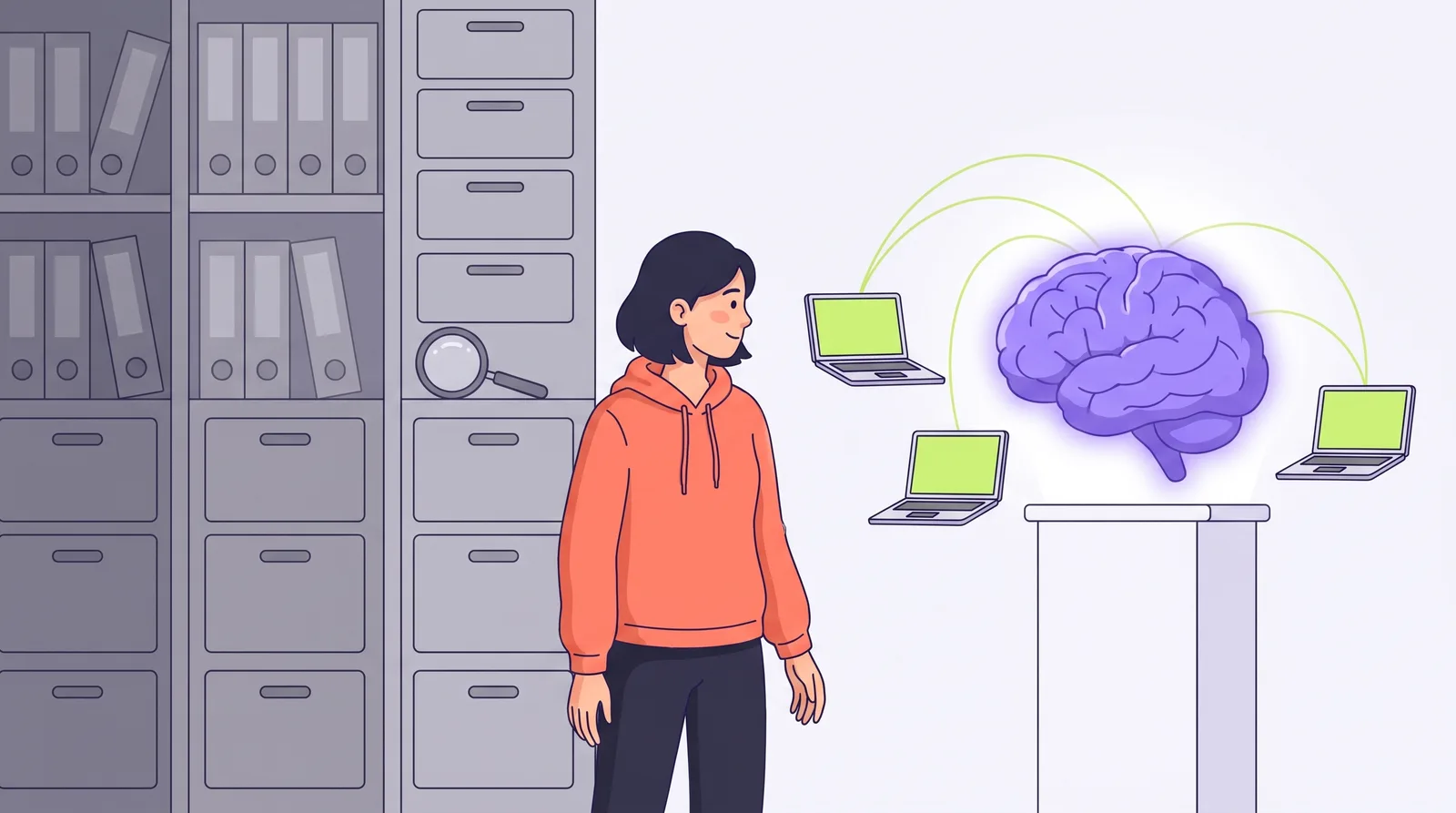
Your team has a wiki. The answer to most questions is probably in there somewhere, but people still have to go through the clutter. Or just ask.
That gets more complicated when you start using AI. You still have to feed it with the context and a thousand other prompts before it can do anything useful.
So the real question is: where should your team’s brain actually live?
A team wiki gives people somewhere to look
There’s nothing wrong with a team wiki. For a small team, it can be a useful place for onboarding policies and project documentation that people need to read and understand.
The problem is that a wiki assumes someone will go looking for the answer. But before one can use the wiki, they have to remember what information exists. And if they can’t find it quickly, they ask a person, instead.
A wiki only documents what your team decided without capturing why. The process might be documented but the reason behind it remains in a Slack conversation. Sooner or later, that missing context becomes a problem, especially when they encounter issues that are not described on the page. It’s like looking through a telephone book not knowing if the entry you are looking for is even there.
This is where a normal wiki starts to struggle
The problem isn’t that wikis are bad. It’s that they were designed around a human being responsible for finding and interpreting the information, which becomes harder when your team has more work happening.
A wiki can go stale when a process changes but nobody updates the page. People can also stop reading documentation when asking a teammate is faster, especially when the answer depends on context that isn’t written down. And the “why” behind a decision is often harder to preserve than the final decision itself.
This is where an AI knowledge base is different.
An AI knowledge base changes who reads the knowledge
Imagine asking ChatGPT to write a proposal for an existing client. Without shared context, you might need to write a long prompt about who the client is or what happened last time.
This is the same problem behind why ChatGPT forgets your company context. The information may already exist, but you still have to give AI permission to access it before it can use it.
An AI knowledge base changes the workflow. Instead of manually finding the information and giving it to AI, you can simply give it the task and let it retrieve the context, without having to copy and paste it into the prompt. That means less time spent re-explaining context to AI every time and remembering how things work.
You don’t have to replace your wiki
An AI knowledge base doesn’t mean your wiki has to disappear. A wiki is still useful when people need to read a complete document.
Keep it if:
- your team can actually find what they need
- your documentation stays reasonably current
- people need to read full documents to understand the work
- AI isn’t yet a regular part of how your team operates
- you don’t spend much time repeating company context
If most of those are true, your wiki may already be doing its job. The point isn’t to replace a system that works, but to recognize when your team’s growing use of AI creates a different knowledge problem.
So, wiki or AI knowledge base?
For most small teams, the answer doesn’t have to be one or the other. Your wiki can remain where people go to read, while an AI knowledge base becomes the shared context layer that your team can use during the work.
The important distinction is what happens after you document something. Can the next person find it? Can they understand the reasoning behind it? Can they apply it to a new situation? And when they ask AI to help, can that AI access the same context without making them explain the company from scratch?
That’s the idea behind giving your team one AI brain. Instead of every person carrying a separate version of your company’s knowledge around in their own chats, your team can give the AI tools they already use access to the same shared context. You don’t have to replace your whole workflow. You just stop making every person carry the company’s context around in their own chat window.
Put your whole team on one shared brain.
Get the free guide to the new way of working with AI, then bring your team along.