
What tasks should I delegate to AI first?
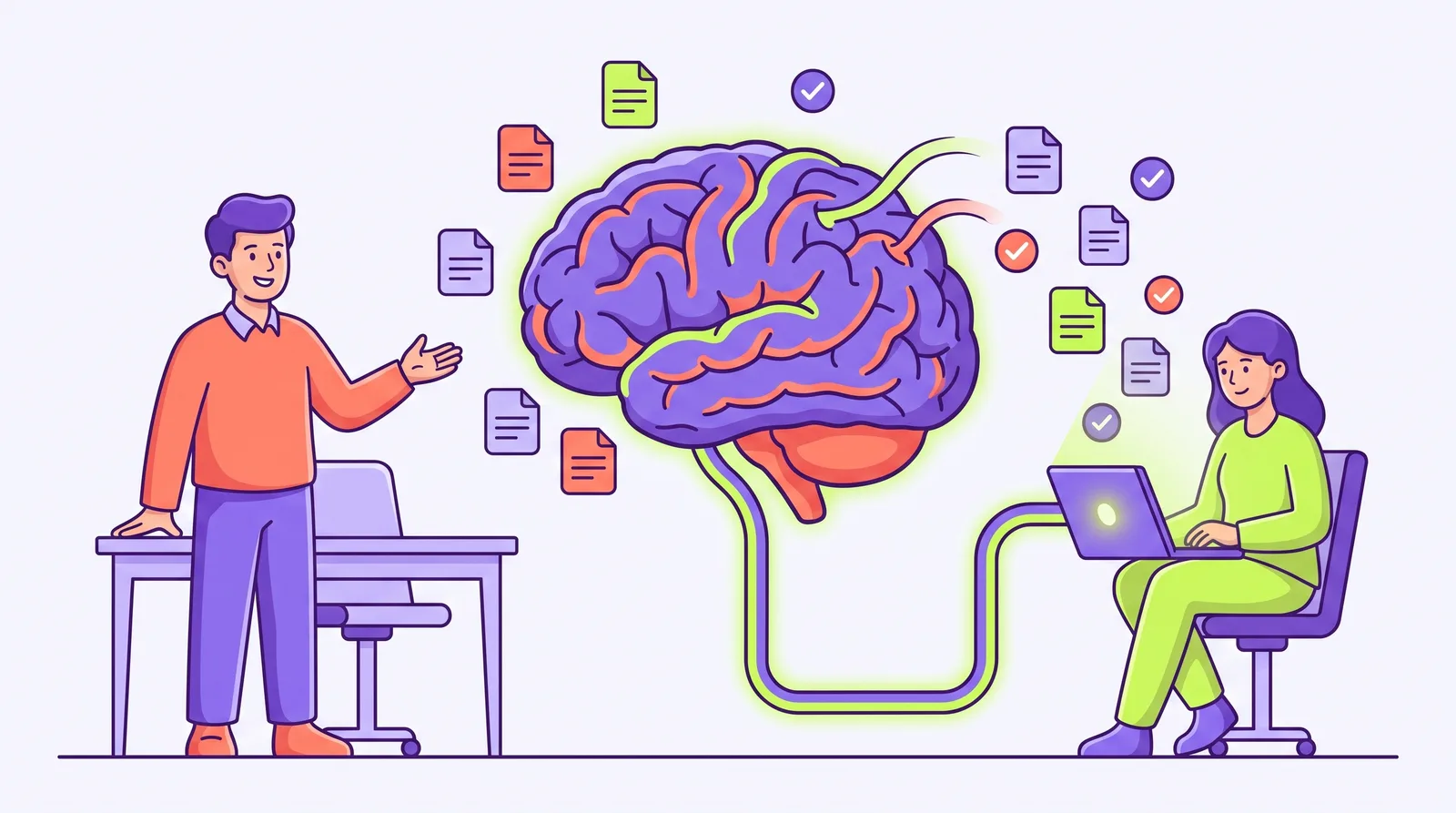
You already use AI. You paste things into Claude or ChatGPT, you get answers back, and some days it’s a real help and other days it’s more work than just doing the thing. Usually that comes down to what you handed it, not the tool itself.
So here’s the question to answer before you spend another hour on it: of everything on your plate, what should go to AI first, and what should stay with you? Below is a way to decide that doesn’t ask you to build anything or learn to code. You already know how to delegate. You’ve done it with people. Handing work to AI is the same thing, pointed at a tool that’s fast and never gets tired, but starts fresh each time you close the tab unless you’ve written down what it needs to know.
Delegate to AI the way you’d delegate to a new hire
When a good manager hands off work, they don’t start with the hardest, riskiest thing on the list. They start with work that’s easy to explain, easy to check, and safe to get wrong. Nobody hands over the big client relationship on day one. They hand over the weekly report, look at how it comes back, and go from there.
Treat AI the same way. The instinct is right, but most people do it backwards. They reach for AI on the big scary thing (“write my whole sales strategy”) and keep doing the small repetitive stuff by hand. Then the big thing comes back generic and they decide AI isn’t ready. It was ready enough. The task was the wrong one to start with.
So flip it. Give away the small, safe, repeatable work first. Keep the judgment calls close until you trust the handoff.
Four questions to decide what to delegate first
Take any task you do and run it through four questions. The more yeses, the sooner it should go to AI.
1. Is it repeatable?
Do you do this often, in about the same shape each time? Weekly summaries, first-draft replies, turning notes into a clean doc, turning a call into action items. Repeatable work is worth the one-time cost of explaining it well, because you get that cost back every time it runs.
One-off work that needs fresh judgment each time is a worse fit early on. Not because AI can’t help, but because you pay the whole “explain it” cost for a single use.
2. Is it low-judgment?
Judgment is the part that lives in your head and is hard to write down. Taste. Reading a room. Knowing this client hates being called by their full name. Low-judgment tasks have a clear right answer or a clear format instead: reformatting, summarizing, drafting from a template, pulling the key points out of a long thread. There’s a target you can describe.
High-judgment tasks are the opposite. If you can’t write down how you decide, AI can’t decide for you. It can still help you think it through. But the call stays yours.
3. Can you write down how it’s done?
This is the one people skip, and it’s the one that decides whether AI feels reliable or hit-and-miss. AI works off what you tell it. If the “how we do this” only lives in your head, every handoff starts from zero and the output comes back generic, because generic is all it had to go on.
The fix is to write the thing down once, not to hunt for a cleverer prompt. How you like the weekly update laid out. The five phrases your brand never uses. The steps of your intake process. Do that once and every future handoff has it. It’s the difference between telling a new hire the same thing forty times and handing them the doc.
4. Is it low-stakes if it’s wrong?
Ask what happens if the output is bad and nobody catches it. A messy internal draft you’ll read before it goes anywhere is low-stakes. A message sent straight to your biggest client with no eyes on it is not. Early on, hand over the work where a mistake costs you five minutes of editing, not a relationship.
This isn’t forever. As you learn where the handoff is solid, you widen the circle. But you earn that, you don’t assume it.
What to hand to AI first
Run the four questions across a normal week and the same kinds of work rise to the top. For a small team, here’s the reliable first batch.
- First drafts of anything. Emails, posts, replies, outlines, proposals. AI drafts, you edit. Editing a decent draft is faster than staring at a blank page, and you keep the final word.
- Summarizing and reformatting. Long thread into three bullets. Messy notes into a clean brief. A call transcript into action items with owners. Clear input, clear target, low risk.
- Turning notes into structure. You brain-dump what a project is, and AI shapes it into steps someone can pick up. This is where a scattered idea becomes work you can hand off.
- Repeatable admin. Drafting the standard client update, formatting a report the same way each week, prepping an agenda from last week’s notes.
- Research legwork. Pulling together what’s out there on a topic so you start from a stack of notes instead of a blank search bar. You still judge what’s true and what matters.
Notice what these share. Each has a clear input, a target you can describe, and a cheap cost of being wrong. When you’re unsure about a new task, don’t ask “can AI do this.” Ask “does this look like the batch above.”
What to keep doing yourself (for now)
Some work should stay with you, and knowing which is which is what separates people who use AI well from people who get burned once and back off.
Keep the relationship calls. The hard conversation with a client, the feedback a teammate needs to hear from a person, the negotiation where tone carries the whole thing. AI can help you prepare. It shouldn’t be the one in the room.
Keep the things you can’t take back. Anything that goes out under your name with no review, anything you can’t undo, anything where a quiet mistake is expensive. Not because it’s off-limits, but because you don’t hand that over until the smaller handoffs have earned your trust.
Keep the real judgment. The strategy call, the “which of these three directions” decision, the read on whether now is the right time. Use AI to lay out the options and pressure-test your thinking. Then you decide. Using AI well means getting a fast second set of hands on the work around the decision, not handing over the decision itself.
Notice “for now” runs through all of it. The line between hand-over and keep moves as you get better at describing your work and checking the output. Let it move because you earned the trust, not because you ran out of patience.
Don’t let the context disappear after one chat
Here’s where the value tends to leak out. You get a great result from AI in one chat, close the tab, and the next day you start over from nothing. Or one person on the team has AI dialed in for a task and everyone else is back at zero. The work got handed off. The context didn’t stick.
Delegating only adds up if the context lives somewhere the next person, and the next AI session, can pick it up. The writing style. The “how we do the weekly update.” The call you made last month and why. When that’s written down in one shared place instead of trapped in someone’s chat history, every handoff starts where the last one ended. That’s the actual work here: a handoff that keeps the context, not a smarter prompt.
This is what TeamBrain does. It’s the shared brain your team and the AI tools you already use both work from, so the context and the process travel with the task instead of living in one person’s head or one lucky chat. You direct the work, and the workspace keeps the thread so nobody has to rebuild it.
Where to start this week
Pick one task. Make it a boring one: the weekly update, the standard client email, the notes-into-brief job you do every Monday. Write down once how you like it done, hand it to AI, and edit what comes back. Do it again next week off the same notes. That loop, one small task written down and handed off cleanly, will teach you more about using AI than any amount of reading.
You don’t need to build anything or become technical. You need to get good at handing off work without losing the thread, to AI and to the people around you. Start with the small, safe, repeatable stuff. Keep the judgment. Widen the circle as the trust grows. You can start on Monday.
Put your whole team on one shared brain.
Get the free guide to the new way of working with AI, then bring your team along.